Complete Guide to Chin Fillers
— Anatomical Principles and Natural Design Strategies for Sculpting a Recessed Chin
A frequently overlooked factor in determining the overall facial impression is the degree of protrusion and shape of the chin apex. The chin influences the clarity of the lower facial line from a frontal view, dictates the E-line (ideal line from tip of nose to chin) from a profile view, and is directly related to the harmony with the nose and lips. This column summarizes the anatomical principles, design strategies, and precautions for chin filler procedures based on scientific evidence.

1. Understanding the Anatomical Structure of the Chin
The chin area is composed of layers in the order of skin, subcutaneous fat, muscle, periosteum, and bone (mandibular symphysis). Clinically significant structures include the following:
① Mental Foramen
This is the exit point of the mental nerve, located below the mandibular premolars, approximately 2.5-3 cm lateral to the midline. Compression of this nerve branch during filler injection can cause numbness or sensory disturbances, necessitating accurate anatomical identification.
② Inferior Labial Artery and Mental Artery
Branches of the inferior labial artery run through the subcutaneous layer of the chin. To prevent intravascular injection, adequate aspiration and low-pressure, slow injection are essential.
③ Mentalis Muscle
This muscle originates from the mandibular bone at the midline and inserts into the chin skin. Depending on the injection plane, it can be injected above the mentalis muscle (intramuscular or subcutaneous) or below it (subperiosteal plane), chosen according to the treatment goal.
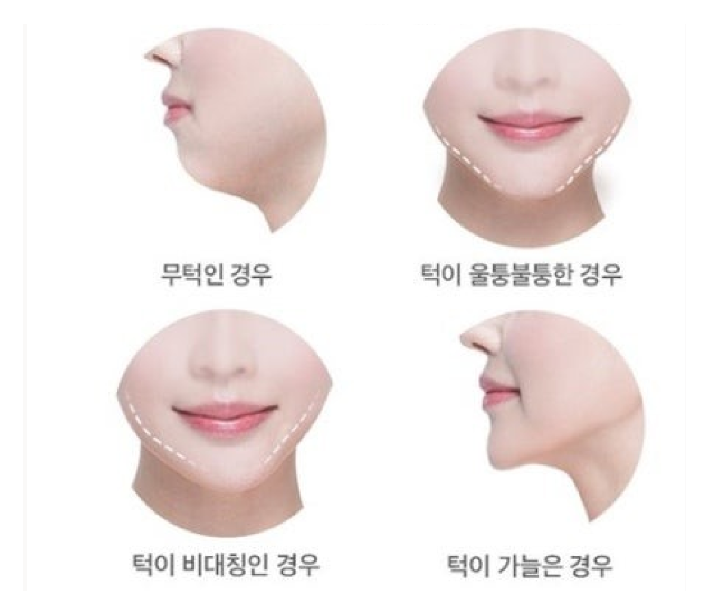
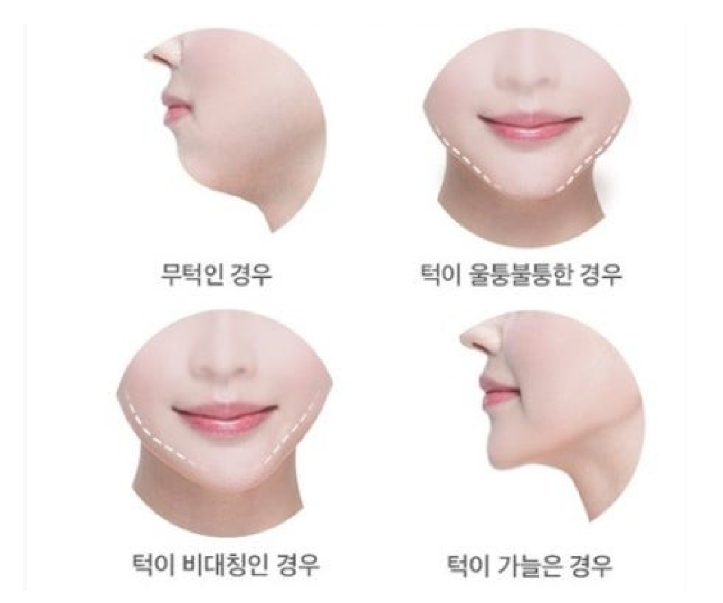
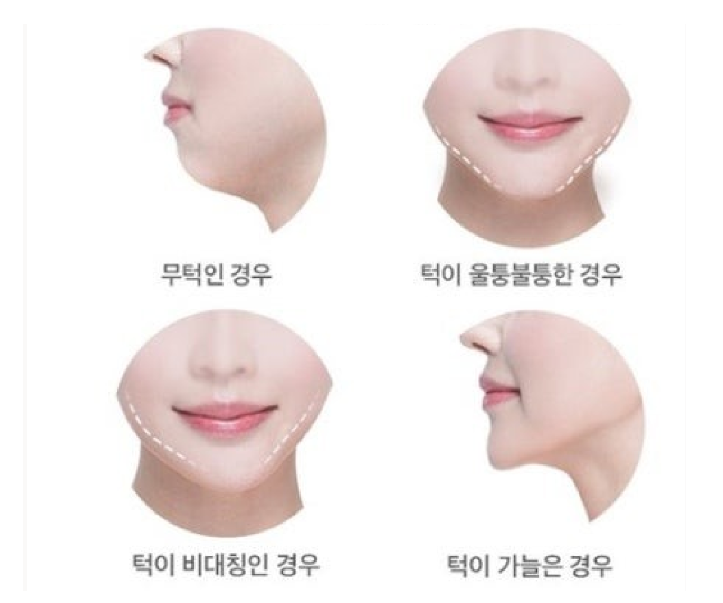
2. Chin Shape Classification and Indications
Hinderer (1971) and subsequent studies classify chin deficiency based on a combined analysis of vertical and horizontal dimensions.
① Retrogenia / Horizontal Deficiency
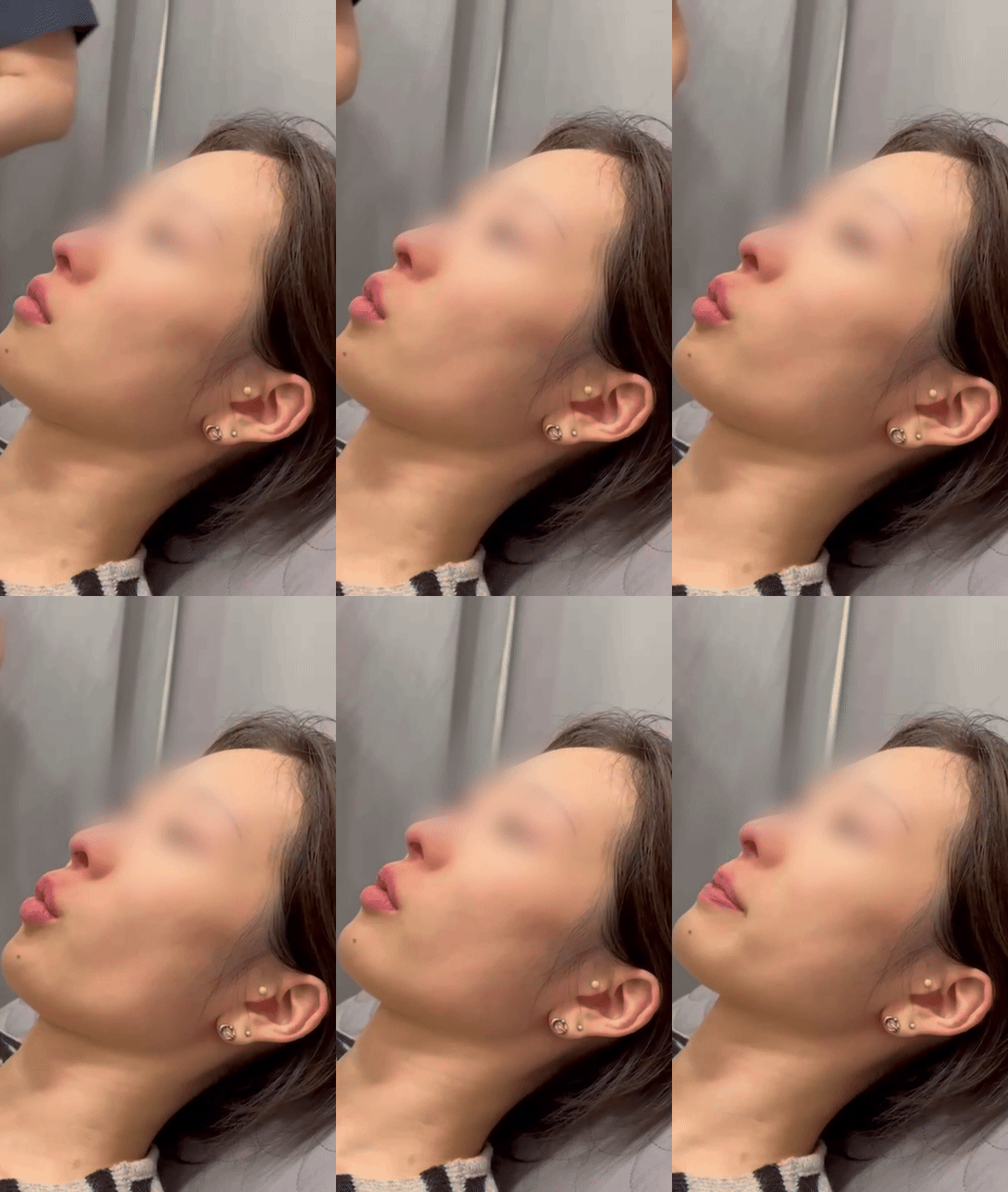
This occurs when the chin is positioned posteriorly relative to the vertical line from the tip of the nose to the chin (Ricketts E-line) in a profile view. Ricketts suggested that the ideal male chin lies on the E-line, while the female chin is approximately 2 mm posterior to it. For cases with significant horizontal recession, fillers with high cohesivity are injected into the supraperiosteal plane for projection.
② Vertical Shortness / Microgenia
This refers to a condition where the lower third of the face is shorter compared to the upper and middle thirds in a frontal view. In such cases, volume is added below the periosteum or distributed around the lateral borders (near the pogonion) to increase vertical height.
③ Asymmetry
In cases of asymmetry, selective augmentation is performed on the deficient side. Clinically, the goal is 'perceptible balance' rather than absolute symmetry for a natural outcome.
④ Witch's Chin / Ptotic Chin
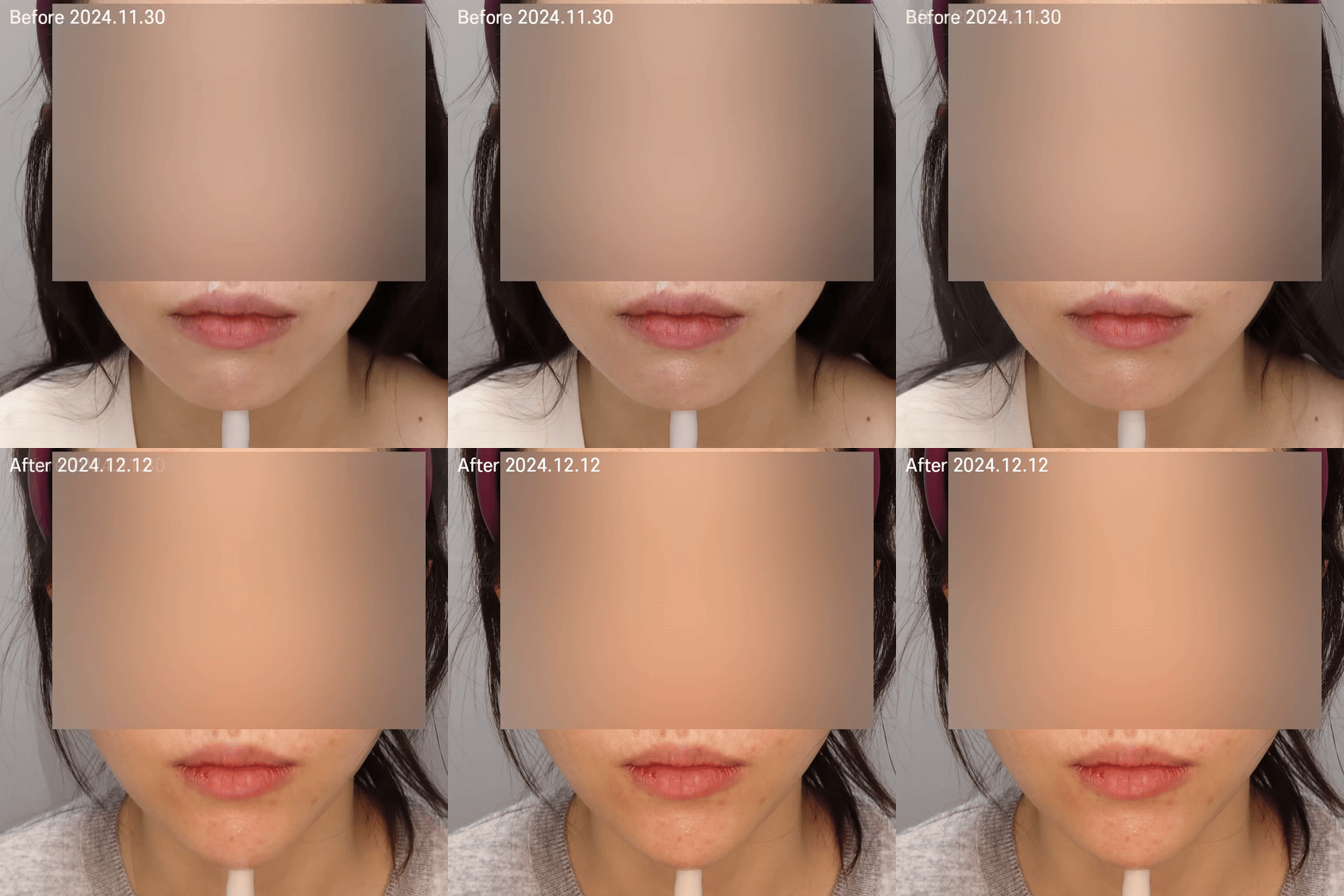
This condition occurs when the chin skin is pulled downwards due to overactivity of the mentalis muscle. In such cases, combining botulinum toxin with fillers can yield more natural results than fillers alone.
3. Filler Selection Criteria — G-prime and Cohesivity
Chin fillers are used for 'structural support' in an area with minimal movement, making filler material selection crucial.
G-prime (Elastic Modulus)
A higher G-prime indicates stronger shape retention and greater resistance to pressure. For areas subject to weight or gravity, like the chin, rheological fillers with high G-prime (e.g., highly cohesive hyaluronic acid fillers) are preferred. Fillers with low G-prime tend to spread laterally, making it difficult to achieve distinct projection.
Cohesivity vs. Fluidity
Monophasic fillers have uniform cross-linking density and tend to spread evenly. Biphasic fillers offer different shape control due to variations in particle size and concentration. Many reports favor monophasic, highly cohesive fillers for the chin, but this requires a thorough understanding of the filler's properties and the practitioner's technique.
4. Injection Plane and Technique — Balancing Safety and Results
The results and safety of chin fillers vary significantly depending on the injection plane.
① Supraperiosteal Plane
This plane is just above the bone, below the mentalis muscle. It offers a low risk of vascular complications and excellent structural support, making it suitable for projection and vertical lengthening. Using a cannula instead of a needle minimizes tissue damage and allows for precise access to this plane.
② Subcutaneous Plane
This plane is suitable for contouring and improving skin surface texture. However, due to the presence of inferior labial artery branches, extreme caution is needed to prevent intravascular injection. Techniques like the fan technique or linear threading with a cannula enhance safety.
③ Intramuscular — Generally Avoided
Injection into the mentalis muscle is generally not recommended as it can lead to filler migration and uneven distribution.
After injection, gentle massage is used to sculpt the filler and ensure smooth blending with the surrounding tissues. However, excessive massage can cause unintended filler migration, so caution is advised.
5. Design Strategy — Harmony with Facial Proportions
Key indicators to consider during chin filler design include:
① E-line (Esthetic line, Ricketts Line)
A straight line connecting the tip of the nose and the chin. Ideally, the upper lip should be on or slightly behind this line, and the lower lip about 2 mm behind it for balance. Significant chin recession can make the lips appear excessively protruded, creating an 'only the lips stick out' impression.
② Frontal Lower Facial Line
The width of the chin should be equal to or slightly narrower than the width of the nostrils for a natural appearance. Excessive lateral spread can create a 'square jaw' look, requiring caution.
③ Gender Differences
Men: Emphasize angular shapes and horizontal projection. Women: Focus on soft, rounded shapes and vertical harmony. Customized designs reflecting gender and individual preferences are essential.
④ Harmony with Nose and Lip Fillers
A comprehensive design considering the balance with the nose and lips, rather than isolated chin correction, significantly enhances the overall facial impression. If the nose tip is low, simultaneous treatment of the nose and chin with fillers can effectively improve E-line harmony.
6. Combined Botulinum Toxin Therapy — Correcting Mentalis Muscle Overactivity
Overactivity of the mentalis muscle can cause the following aesthetic issues:
- Cobblestone or dimpled appearance of the chin skin due to mentalis muscle contraction.
- Witch's chin appearance, where the chin seems pulled downwards and shortened.
- Reduced filler longevity, as continuous muscle contraction can lead to premature filler dispersion.
In such cases, injecting a small amount of botulinum toxin into the mentalis muscle can relax overactivity, smoothing the chin skin and extending the filler's effect. Mentalis botulinum toxin is typically administered in doses of 10-20 units, requiring precise injection near the midline to avoid affecting the lower lip.
7. Duration and Aftercare
The duration of chin filler effects varies depending on the type of filler, injection plane, and individual metabolism, but generally lasts as follows:
- Hyaluronic Acid Fillers: 12-18 months (relatively longer duration when injected into the supraperiosteal plane).
- Sculptra/Juvéderm (Collagen Stimulating Fillers): 1.5-2+ years (natural volume maintenance through collagenesis).
- Combined with Mentalis Botulinum Toxin: Botulinum toxin effects last 3-4 months; synergistic effect when combined with fillers.
For 48-72 hours post-procedure, avoid massaging, hot compresses, or excessive pressure on the treated area. When sleeping, try to avoid lying on your side in a way that puts continuous pressure on your face.
8. Recommended for Those Who:
✔ Appear to have lips that protrude excessively in profile photos.
✔ Have a short or undefined lower facial line from the front.
✔ Have good nose and lip proportions but feel their overall facial impression is lacking.
✔ Appear to have a double chin, but the cause is more due to a lack of chin definition rather than excess fat.
✔ Desire to improve overall facial contour in conjunction with nose and lip fillers.
Conversely, for significant skeletal issues, severe asymmetry, or accompanying skin laxity, a comprehensive treatment plan beyond simple fillers is necessary, requiring a precise diagnosis.
BA Clinic Consultation Information
Chin fillers yield natural and safe results when performed with a deep understanding of anatomical structures and filler rheology.
At BA Clinic, we perform personalized chin filler treatments based on precise analysis of frontal and profile facial proportions, considering the location of the mental foramen and blood vessels. We strive for natural improvements by approaching the procedure from the perspective of overall facial balance, including combined treatments like mentalis botulinum toxin and integrated designs with nose and lip fillers.
Please feel free to contact BA Clinic with any questions.
Complete Guide to Chin Fillers
— Anatomical Principles and Natural Design Strategies for Sculpting a Recessed Chin
A frequently overlooked factor in determining the overall facial impression is the degree of protrusion and shape of the chin apex. The chin influences the clarity of the lower facial line from a frontal view, dictates the E-line (ideal line from tip of nose to chin) from a profile view, and is directly related to the harmony with the nose and lips. This column summarizes the anatomical principles, design strategies, and precautions for chin filler procedures based on scientific evidence.
1. Understanding the Anatomical Structure of the Chin
The chin area is composed of layers in the order of skin, subcutaneous fat, muscle, periosteum, and bone (mandibular symphysis). Clinically significant structures include the following:
① Mental Foramen
This is the exit point of the mental nerve, located below the mandibular premolars, approximately 2.5-3 cm lateral to the midline. Compression of this nerve branch during filler injection can cause numbness or sensory disturbances, necessitating accurate anatomical identification.
② Inferior Labial Artery and Mental Artery
Branches of the inferior labial artery run through the subcutaneous layer of the chin. To prevent intravascular injection, adequate aspiration and low-pressure, slow injection are essential.
③ Mentalis Muscle
This muscle originates from the mandibular bone at the midline and inserts into the chin skin. Depending on the injection plane, it can be injected above the mentalis muscle (intramuscular or subcutaneous) or below it (subperiosteal plane), chosen according to the treatment goal.
2. Chin Shape Classification and Indications
Hinderer (1971) and subsequent studies classify chin deficiency based on a combined analysis of vertical and horizontal dimensions.
① Retrogenia / Horizontal Deficiency
This occurs when the chin is positioned posteriorly relative to the vertical line from the tip of the nose to the chin (Ricketts E-line) in a profile view. Ricketts suggested that the ideal male chin lies on the E-line, while the female chin is approximately 2 mm posterior to it. For cases with significant horizontal recession, fillers with high cohesivity are injected into the supraperiosteal plane for projection.
② Vertical Shortness / Microgenia
This refers to a condition where the lower third of the face is shorter compared to the upper and middle thirds in a frontal view. In such cases, volume is added below the periosteum or distributed around the lateral borders (near the pogonion) to increase vertical height.
③ Asymmetry
In cases of asymmetry, selective augmentation is performed on the deficient side. Clinically, the goal is 'perceptible balance' rather than absolute symmetry for a natural outcome.
④ Witch's Chin / Ptotic Chin
This condition occurs when the chin skin is pulled downwards due to overactivity of the mentalis muscle. In such cases, combining botulinum toxin with fillers can yield more natural results than fillers alone.
3. Filler Selection Criteria — G-prime and Cohesivity
Chin fillers are used for 'structural support' in an area with minimal movement, making filler material selection crucial.
G-prime (Elastic Modulus)
A higher G-prime indicates stronger shape retention and greater resistance to pressure. For areas subject to weight or gravity, like the chin, rheological fillers with high G-prime (e.g., highly cohesive hyaluronic acid fillers) are preferred. Fillers with low G-prime tend to spread laterally, making it difficult to achieve distinct projection.
Cohesivity vs. Fluidity
Monophasic fillers have uniform cross-linking density and tend to spread evenly. Biphasic fillers offer different shape control due to variations in particle size and concentration. Many reports favor monophasic, highly cohesive fillers for the chin, but this requires a thorough understanding of the filler's properties and the practitioner's technique.
4. Injection Plane and Technique — Balancing Safety and Results
The results and safety of chin fillers vary significantly depending on the injection plane.
① Supraperiosteal Plane
This plane is just above the bone, below the mentalis muscle. It offers a low risk of vascular complications and excellent structural support, making it suitable for projection and vertical lengthening. Using a cannula instead of a needle minimizes tissue damage and allows for precise access to this plane.
② Subcutaneous Plane
This plane is suitable for contouring and improving skin surface texture. However, due to the presence of inferior labial artery branches, extreme caution is needed to prevent intravascular injection. Techniques like the fan technique or linear threading with a cannula enhance safety.
③ Intramuscular — Generally Avoided
Injection into the mentalis muscle is generally not recommended as it can lead to filler migration and uneven distribution.
After injection, gentle massage is used to sculpt the filler and ensure smooth blending with the surrounding tissues. However, excessive massage can cause unintended filler migration, so caution is advised.
5. Design Strategy — Harmony with Facial Proportions
Key indicators to consider during chin filler design include:
① E-line (Esthetic line, Ricketts Line)
A straight line connecting the tip of the nose and the chin. Ideally, the upper lip should be on or slightly behind this line, and the lower lip about 2 mm behind it for balance. Significant chin recession can make the lips appear excessively protruded, creating an 'only the lips stick out' impression.
② Frontal Lower Facial Line
The width of the chin should be equal to or slightly narrower than the width of the nostrils for a natural appearance. Excessive lateral spread can create a 'square jaw' look, requiring caution.
③ Gender Differences
Men: Emphasize angular shapes and horizontal projection. Women: Focus on soft, rounded shapes and vertical harmony. Customized designs reflecting gender and individual preferences are essential.
④ Harmony with Nose and Lip Fillers
A comprehensive design considering the balance with the nose and lips, rather than isolated chin correction, significantly enhances the overall facial impression. If the nose tip is low, simultaneous treatment of the nose and chin with fillers can effectively improve E-line harmony.
6. Combined Botulinum Toxin Therapy — Correcting Mentalis Muscle Overactivity
Overactivity of the mentalis muscle can cause the following aesthetic issues:
- Cobblestone or dimpled appearance of the chin skin due to mentalis muscle contraction.
- Witch's chin appearance, where the chin seems pulled downwards and shortened.
- Reduced filler longevity, as continuous muscle contraction can lead to premature filler dispersion.
In such cases, injecting a small amount of botulinum toxin into the mentalis muscle can relax overactivity, smoothing the chin skin and extending the filler's effect. Mentalis botulinum toxin is typically administered in doses of 10-20 units, requiring precise injection near the midline to avoid affecting the lower lip.
7. Duration and Aftercare
The duration of chin filler effects varies depending on the type of filler, injection plane, and individual metabolism, but generally lasts as follows:
- Hyaluronic Acid Fillers: 12-18 months (relatively longer duration when injected into the supraperiosteal plane).
- Sculptra/Juvéderm (Collagen Stimulating Fillers): 1.5-2+ years (natural volume maintenance through collagenesis).
- Combined with Mentalis Botulinum Toxin: Botulinum toxin effects last 3-4 months; synergistic effect when combined with fillers.
For 48-72 hours post-procedure, avoid massaging, hot compresses, or excessive pressure on the treated area. When sleeping, try to avoid lying on your side in a way that puts continuous pressure on your face.
8. Recommended for Those Who:
✔ Appear to have lips that protrude excessively in profile photos.
✔ Have a short or undefined lower facial line from the front.
✔ Have good nose and lip proportions but feel their overall facial impression is lacking.
✔ Appear to have a double chin, but the cause is more due to a lack of chin definition rather than excess fat.
✔ Desire to improve overall facial contour in conjunction with nose and lip fillers.
Conversely, for significant skeletal issues, severe asymmetry, or accompanying skin laxity, a comprehensive treatment plan beyond simple fillers is necessary, requiring a precise diagnosis.
BA Clinic Consultation Information Chin fillers yield natural and safe results when performed with a deep understanding of anatomical structures and filler rheology. At BA Clinic, we perform personalized chin filler treatments based on precise analysis of frontal and profile facial proportions, considering the location of the mental foramen and blood vessels. We strive for natural improvements by approaching the procedure from the perspective of overall facial balance, including combined treatments like mentalis botulinum toxin and integrated designs with nose and lip fillers. Please feel free to contact BA Clinic with any questions. |