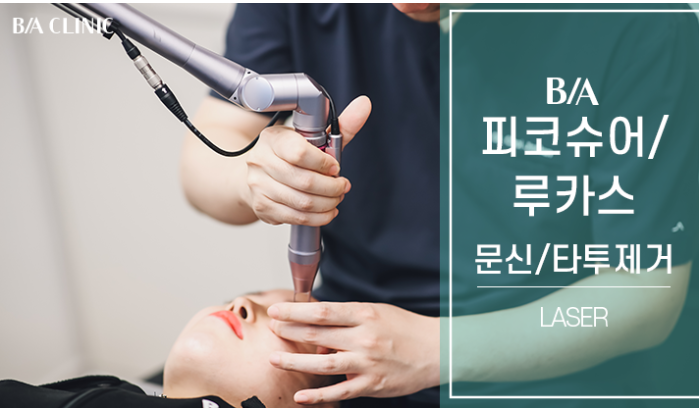
— Why Tattoos Don't Easily Fade: Immunological Fixation Mechanism of Ink Particles in the Skin
Tattoos involve the artificial insertion of external pigment particles into the dermis layer of the skin. The inserted ink particles are engulfed by macrophages of the skin's immune system, but because the particle size is large, at several micrometers (μm), macrophages cannot completely break them down. As a result, macrophages containing ink become semi-permanently fixed within the dermis, maintaining the tattoo.
Understanding this process clarifies the core principle of tattoo removal: it is about physically fragmenting the pigment particles fixed within the dermis with laser energy, making them small enough for macrophages to process. The fragmented micro-particles are then expelled from the body via the lymphatic system or re-engulfed and metabolized.
1. Q-Switched Laser vs. Picosecond Laser — Generational Technological Differences and Clinical Significance
Lasers used for tattoo removal are broadly divided into two generations.
▶ 1st Generation: Q-Switched Laser
These lasers have pulse durations in the nanosecond (10⁻⁹ seconds) range. Wavelengths such as Nd:YAG (1064nm, 532nm), Alexandrite (755nm), and Ruby (694nm) are used. They deliver photothermal energy to ink particles, inducing thermal expansion and partial fragmentation. However, nanosecond pulses are longer than the thermal relaxation time, which can cause thermal damage to surrounding tissues, leading to scars and hyperpigmentation.
▶ 2nd Generation: Picosecond Laser
These lasers use ultrashort pulses in the picosecond (10⁻¹² seconds) range. Thanks to this short pulse duration, thermal diffusion is minimal, and instead, the photoacoustic effect is the primary mechanism. Energy concentrated instantaneously on ink particles generates acoustic shockwaves, mechanically fragmenting the particles. This process minimizes damage to surrounding tissues and allows for finer particle fragmentation at the same energy density.
Clinically, numerous comparative studies have reported that picosecond lasers can reduce the average number of treatment sessions by 30-40% compared to Q-switched lasers, and the incidence of side effects such as hyperpigmentation and scarring is also significantly lower.
2. Laser Wavelength Selection by Ink Color — Clinical Application of Selective Photothermolysis
Tattoo inks absorb different wavelengths of light depending on their color. This is the principle of Selective Photothermolysis, and effective fragmentation requires selecting the laser wavelength that each pigment absorbs most strongly.
- Black/Dark Gray: 1064nm (Nd:YAG) — Has the broadest absorption spectrum, reacting to almost all laser wavelengths, and is most efficiently fragmented at 1064nm. Black is the easiest color to remove.
- Red: 532nm (KTP, frequency-doubled Nd:YAG) — Shows high absorption for green-spectrum wavelengths.
- Green/Teal: 755nm (Alexandrite) or 694nm (Ruby) — These were difficult colors during the Q-switched era, but treatment efficiency has significantly improved with photoacoustic fragmentation by picosecond lasers.
- Blue/Purple: 694nm or 755nm — Selective absorption occurs with red-spectrum wavelengths.
- Yellow/Orange/White: These colors are difficult for laser absorption due to high reflectivity, requiring multi-wavelength combination therapy, and complete removal may sometimes be challenging.
Therefore, for multi-colored tattoos containing various shades, a multi-wavelength picosecond laser system that can selectively combine several wavelengths is advantageous.
3. Key Factors Influencing Treatment Response — Kirby-Desai Scale and Treatment Plan Establishment
The number of treatment sessions and the outcome of tattoo removal are determined by various variables. In clinical practice, the Kirby-Desai Scale is used as an assessment tool, and the following items are comprehensively evaluated to estimate the expected number of treatment sessions.
- Skin Type (Fitzpatrick skin type): In skin with high melanin content (type IV~VI), laser energy is also absorbed by epidermal melanin, increasing the risk of hyperpigmentation and hypopigmentation. Therefore, for Asians (mostly type III~IV), wavelength selection and energy density adjustment are particularly important.
- Tattoo Location: Areas with rich blood flow (neck, face) have active lymphatic drainage, leading to relatively faster pigment removal, while distal areas (fingers, ankles) have slower circulation, resulting in a slower treatment response.
- Ink Volume and Density: Areas with thickly inserted ink (cover-up tattoos, professional tattoos) require more treatment sessions than amateur tattoos with shallow ink insertion.
- Tattoo Age: Older tattoos tend to respond better to laser treatment than new tattoos, as the natural metabolism of macrophages in the body reduces some ink density.
- Number of Ink Colors: Monochromatic tattoos (especially black) can be effectively treated with a single wavelength, but multi-colored tattoos require a complex wavelength strategy.
Accurately evaluating these factors before the procedure and designing a personalized treatment protocol is key to the treatment outcome.
4. Procedure Process and Treatment Intervals — Protocol Considering Skin Regeneration Cycle and Immune Response
Tattoo removal laser procedures generally proceed as follows:
(1) Pre-procedure Evaluation: Comprehensive diagnosis of tattoo size, color, depth, skin type, and previous treatment history. At this stage, the patient is informed in advance of the estimated number of treatment sessions and expected effects.
(2) Anesthesia and Laser Irradiation: After minimizing pain using local anesthetic cream or a cooling device, the laser is irradiated with a wavelength and energy density appropriate for the specific color. In the case of picosecond lasers, ink particles are effectively fragmented even with a single irradiation, and temporary frost-like whitening is observed immediately after the procedure. This is due to gas bubbles generated around the ink particles and is a normal treatment response.
(3) Post-procedure Care: Antibiotic ointment is applied to the treated area, and dressing is performed. Bruising, swelling, and scab formation may occur for 1-2 weeks, and sun protection is essential. To prevent hyperpigmentation, direct sun exposure should be avoided for at least 4-6 weeks after the procedure.
(4) Treatment Intervals: A minimum interval of 6-8 weeks between sessions is generally recommended. This allows sufficient time for fragmented ink particles to be removed by macrophages and for skin tissue to recover. Hastily reducing the interval can lead to cumulative tissue damage and increased risk of scarring.
5. Realistic Expectations for Tattoo Removal — Complete Removal and Residual Traces
It is important to have realistic expectations for tattoo removal. For amateur tattoos (self-tattoos, shallow insertion), 90% or more removal is often possible with 3-5 treatments. In contrast, professional tattoos, with uniform ink density and insertion depth, may require 6-12 or more treatments.
Complete removal may be difficult in the following cases, and it is crucial to be fully informed about these possibilities beforehand:
- When high-reflectivity inks such as white, flesh-toned, or yellow are used.
- When multiple cover-ups have been performed, resulting in a thick ink layer.
- When fibrosis has progressed due to previous laser treatments.
- When fluorescent or UV-reactive special inks are used.
In such cases, residual traces (ghost images) may remain, but with the latest pico laser technology and sufficient treatment sessions, improvement to a level where they are almost imperceptible to the naked eye can be achieved.
6. Why Tattoo Removal Should Be Performed at an Experienced Medical Institution
Tattoo removal is not merely a procedure of laser irradiation. Each treatment session involves a repeated decision-making process of precisely evaluating the amount of residual ink, skin reaction, and pigment changes, and adjusting the wavelength, energy, and spot size for the next session.
Experienced medical staff perform the following assessments during each session:
- Selecting the optimal wavelength for the currently remaining ink color.
- Adjusting energy density based on skin reaction (hyperpigmentation, hypopigmentation, scarring tendency).
- Appropriately setting treatment intervals and evaluating skin recovery.
- Designing a long-term treatment roadmap that comprehensively considers the patient's skin type and tattoo characteristics.
At BA Clinic, after comprehensively analyzing the tattoo's color, size, depth, and skin type, we design a personalized laser protocol. Through thorough consultation before the procedure, we transparently inform patients about the estimated number of treatments, expected effects, and precautions, aiming to achieve maximum results with minimal side effects.
If you have any questions about tattoo removal, please feel free to request a consultation at BA Clinic.