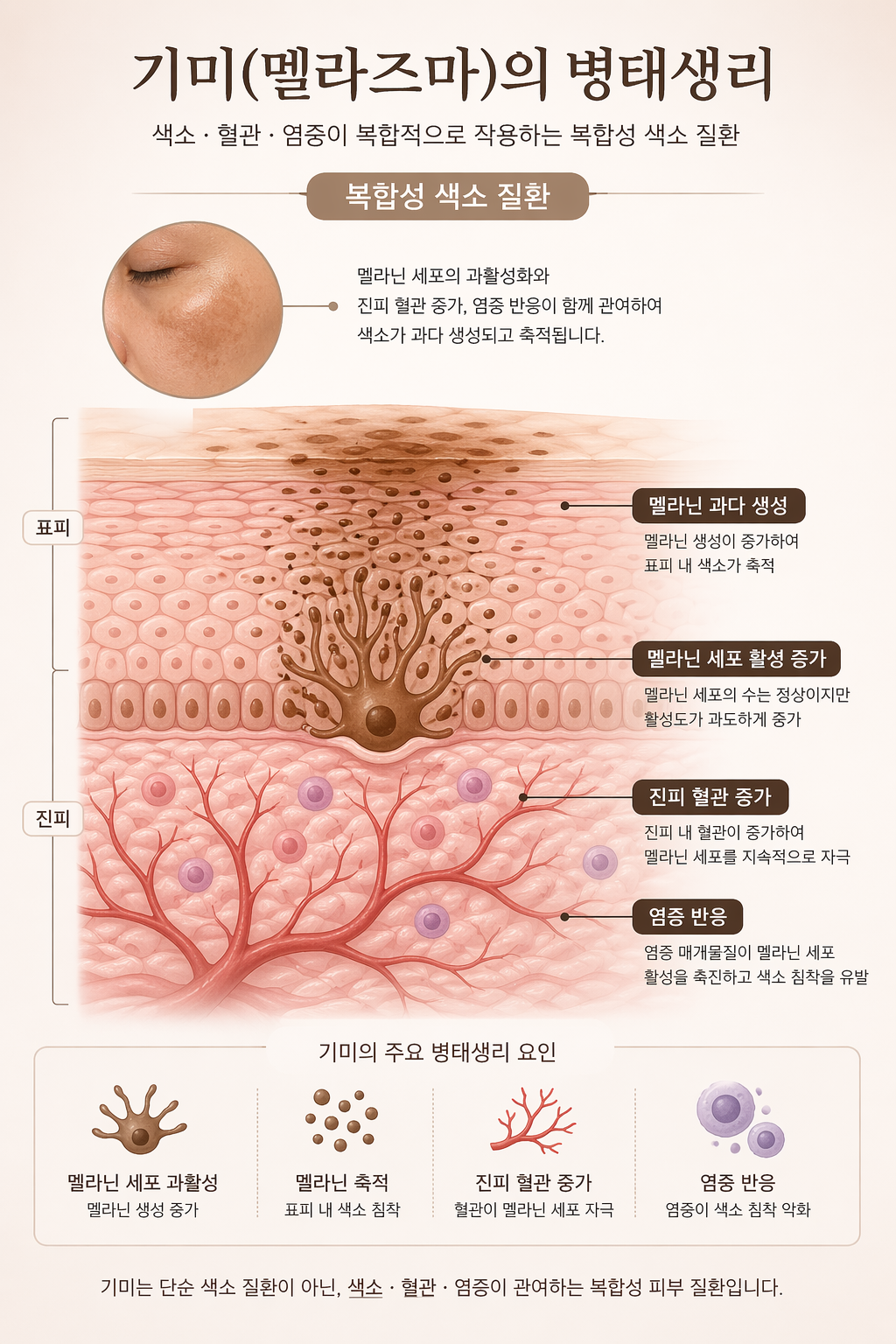
What is Melasma – A Complex Skin Problem, Not Just Simple Pigmentation
Melasma is often simply perceived as "something that appears with age" or "something caused by UV rays." However, in actual dermatological practice, melasma is one of the most challenging pigmentary disorders to treat, with frequent recurrences. It doesn't simply disappear with laser treatment alone, nor is it resolved by just applying medication.
Melasma is a condition where melanocytes in the epidermis become abnormally activated, leading to excessive production and accumulation of melanin pigment. It tends to appear symmetrically, especially around the cheekbones, forehead, upper nose, and upper lip. UV radiation, female hormones (estrogen and progesterone), heat, and stress act as aggravating factors.
Important anatomical features include the fact that the number of melanocytes itself is normal, but their activity is excessively high, and it is accompanied by dermal vascularity and photoaging. These two factors are why melasma should be understood not as a simple pigmentary disorder, but as a 'vascular-pigment-inflammatory complex disease.'
Why Melasma Treatment is Difficult – Why Lasers Alone Are Insufficient
Many people experience that "melasma laser treatment made it even darker." This is a problem of treatment method selection. Excessive application of high-power lasers (such as Q-switched Nd:YAG) can stimulate melanocytes, leading to post-inflammatory hyperpigmentation (PIH). This is a major reason why lasers can have a counterproductive effect in melasma treatment.
The reasons why melasma treatment is complex can be summarized as follows:
1. High Likelihood of Recurrence
Since melanocytes themselves are not removed, they can reactivate at any time with UV exposure or hormonal changes. Melasma treatment should be approached as 'management' rather than 'cure.'
2. Coexistence of Epidermal and Dermal Types
Upon examination with a Wood's lamp or dermoscopy, melasma is classified into epidermal type, dermal type, and mixed type. Epidermal type responds relatively well to lasers, but dermal or mixed types have pigment deeply embedded in the dermis, making them difficult to access with conventional lasers.
3. Associated Vascular Proliferation Sustains Melasma
Recent research has revealed that blood vessels proliferate in the dermal layer beneath melasma lesions, and these vessels continuously activate melanocytes. Therefore, targeting only pigment is an incomplete treatment.
The Core of Effective Melasma Treatment – Combination Approach
At BA Clinic, the most emphasized principle when designing melasma treatment is "combination therapy over single therapy." True improvement in melasma is possible only by simultaneously addressing three axes: pigment, blood vessels, and recurrence prevention.
① Low-Fluence Toning Laser – Suppressing Melanocyte Overactivity
Repeated irradiation with a Q-switched Nd:YAG laser at low fluence, known as 'laser toning,' selectively destroys melanosomes without excessively stimulating melanocytes. The 1064nm wavelength reaches not only the epidermis but also the upper dermis, providing some effect on mixed-type melasma.
However, excessive treatment sessions or high power application can cause melanocyte vacuolization or marginal depigmentation, making precise control of power and interval extremely important.
② Picosecond Laser – More Delicate Pigment Fragmentation
Picosecond lasers, which use ultrashort pulses in picosecond (10⁻¹² seconds) units, minimize thermal damage compared to conventional nanosecond lasers while fragmenting pigment more finely. These smaller particles can be more easily removed by the body's immune cells (macrophages). In particular, utilizing the focused lens array of picosecond lasers can also induce dermal collagen remodeling, allowing for simultaneous improvement in melasma treatment and skin texture.
③ Vascular Laser – Blocking the Vascular Basis of Melasma
PDL (Pulsed Dye Laser) with 585nm or 595nm wavelength or 532nm KTP laser selectively targets dermal blood vessels. By reducing vascular components, it improves the environment that continuously activates melanocytes. The combination of pigment lasers and vascular lasers shows excellent efficacy, especially in recurrent and refractory melasma.
④ Topical Agents – Key to Recurrence Prevention and Maintenance
Combining topical agents with laser treatment is an essential component of melasma management. Representative ingredients include:
- Hydroquinone: A powerful whitening ingredient that inhibits the tyrosinase enzyme, blocking melanin synthesis. It should be used for short, intensive periods followed by a break, as long-term overuse can lead to side effects such as ochronosis.
- Tretinoin: A retinoid that accelerates keratin turnover, rapidly shedding epidermal melanin. Its combination with hydroquinone (Kligman formula) has long been a standard method for melasma treatment.
- Azelaic acid, Kojic acid, Niacinamide: Less irritating, used for sensitive skin or during the maintenance phase.
⑤ Sun Protection – A Prerequisite for All Treatments
Regardless of the treatment received, melasma will immediately recur if sun protection is not maintained. Daily use of sunscreen with SPF 50+, PA+++ or higher every morning and reapplication every 2-3 hours is fundamental for melasma management. For those with extensive outdoor activities, physical sun protection (hats, parasols) should also be combined.
Step-by-Step Treatment Approach – Customized Protocol Based on Condition
The treatment sequence and intensity must be adjusted according to the severity and type of melasma.
Early/Mild Melasma: Laser toning or picosecond laser alone + combination with topical agents. Strict sun protection.
Moderate/Mixed-Type Melasma: Picosecond laser + vascular laser combination + topical agents (including hydroquinone). Treatments at 3-4 week intervals.
Refractory/Recurrent Melasma: Analysis of previous treatment history → priority application of vascular laser → maintenance with low-fluence picotoning → consideration of combination with oral medications (tranexamic acid, vitamin C, etc.).
BA Clinic's Approach to Melasma Treatment – Starting with Accurate Diagnosis
At BA Clinic, before starting melasma treatment, we always confirm the type of melasma (epidermal/dermal/mixed) and the presence of associated vascular proliferation. This is because even for the same melasma, the treatment direction can vary completely depending on the skin condition and underlying causes.
Instead of simply repeating standardized procedures under the name of "melasma laser," we design customized melasma treatment that comprehensively manages the three axes: pigment, blood vessels, and recurrence prevention. Prescription of topical agents and education on lifestyle management to maintain treatment effects are also provided, which we believe is the most reliable way to effectively manage melasma long-term.
For those struggling with melasma, we recommend seeking a more fundamental solution through accurate diagnosis and a combination treatment plan, rather than simply an approach of "a few laser sessions."