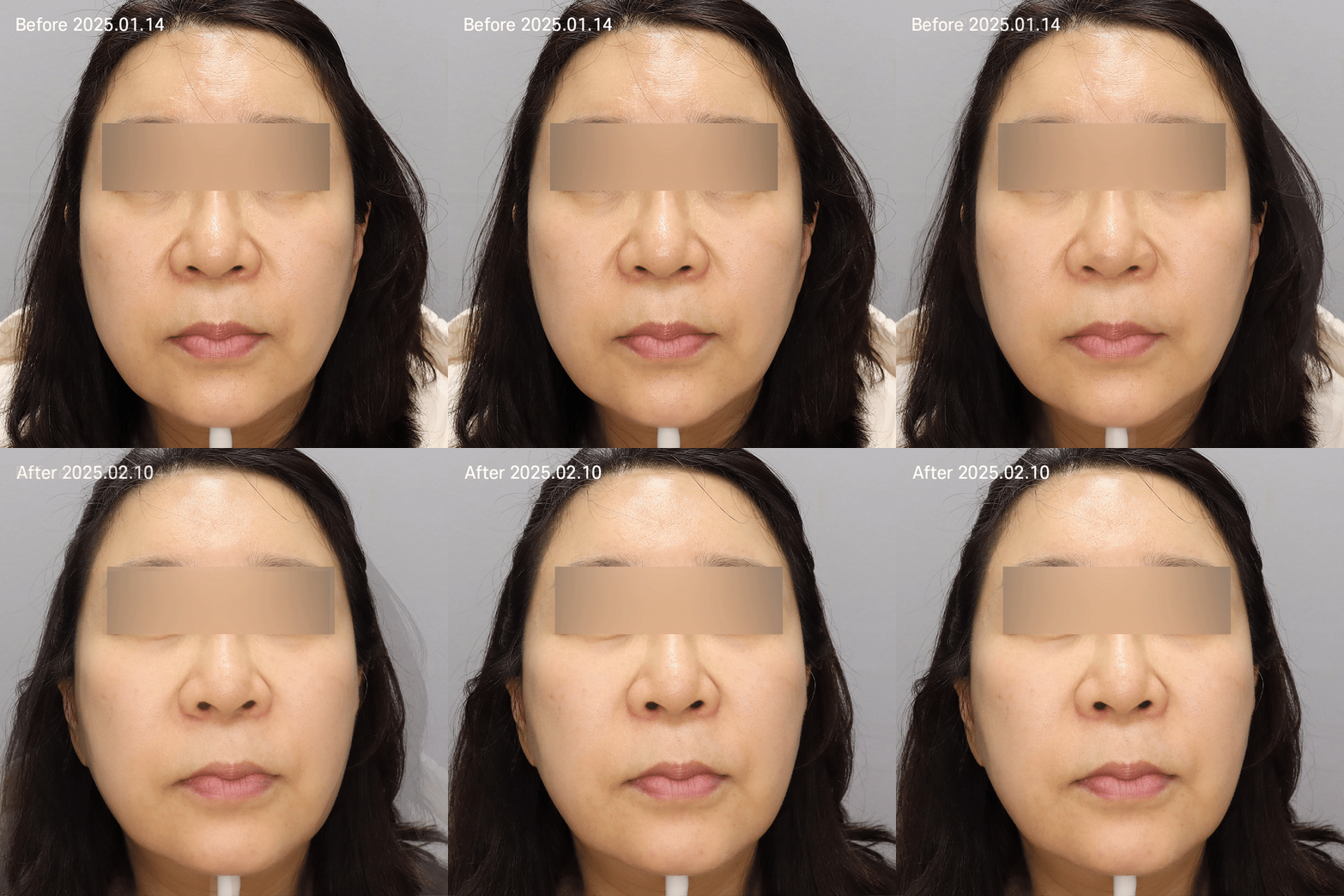
— Lifting Procedures: Why Understanding the 'Layer of Action' is Crucial
Lifting procedures are among the most frequently performed non-surgical anti-aging treatments in dermatology and plastic surgery. However, the actual mechanisms of action and target layers for procedures grouped under the umbrella term 'lifting' vary significantly.
Silhouette Lifting (thread insertion procedures using PDO, PCL, etc.), Ultherapy (High-Intensity Focused Ultrasound, HIFU), and Thermage (Radiofrequency-based procedure) each act on different anatomical layers, leading to distinct expected outcomes, durations of effect, and indications.
In this column, we will compare the anatomical mechanisms of action of these three representative lifting procedures and outline, from a medical perspective, which procedure is suitable for which condition.
1. Silhouette Lifting — Providing Physical Support to the SMAS and Subcutaneous Fat Layer
Silhouette Lifting involves inserting absorbable medical threads (PDO, PCL, PLLA, etc.) into the subcutaneous tissue to physically lift and support the tissues.
The primary layers of action are the subcutaneous fat layer to the SMAS (Superficial Musculoaponeurotic System), with the range of action varying depending on the type of thread and insertion depth.
Key Principles:
- Threads with cogs physically grasp and pull tissues, providing an immediate lifting effect.
- Collagen remodeling is induced around the inserted threads, maintaining structural support for a period even after the threads are absorbed.
- The absorption rate and collagen production pattern differ based on the thread material (PDO vs. PCL vs. PLLA).
Suitable For:
- Cases with evident gravitational descent of tissues in the mid and lower face, such as sagging cheeks and jowls.
- When seeking both immediate contour improvement and collagen remodeling simultaneously.
- Situations where 'correction of tissue position' is needed more than improving skin elasticity itself.
Precautions:
- Results can vary significantly depending on the practitioner's anatomical understanding. Accurate knowledge of the facial nerve pathways, vascular distribution, and SMAS thickness variations is crucial for safe and natural outcomes.
- The naturalness of the results depends on the design of the thread insertion vectors (direction) and fixation points.
2. Ultherapy (HIFU) — Non-invasively Contraction of the SMAS Layer
Ultherapy uses High-Intensity Focused Ultrasound (HIFU) to create thermal coagulation points in the deep tissues without damaging the skin surface.
Its most significant feature is its ability to reach the SMAS layer (approximately 4.5mm deep). This depth is difficult for conventional non-surgical procedures to reach and was previously only accessible through surgical lifting (facelift).
Key Principles:
- Focused ultrasound creates thermal coagulation points at specific depths (1.5mm, 3.0mm, 4.5mm).
- Heat-induced protein denaturation causes contraction of collagen fibers in the SMAS and dermal tissues.
- Over several weeks to months, new collagen (neocollagenesis) is generated, leading to a gradual lifting effect.
Suitable For:
- Moderate skin laxity, when seeking both overall elasticity improvement and lifting.
- Concerns about sagging throughout the face, particularly the jawline, double chin, and brow lift.
- When immediate return to daily activities is required post-procedure (minimal downtime).
Precautions:
- In areas with very thin subcutaneous fat, there is a risk of nerve damage during energy delivery. Therefore, output and depth must be adjusted based on anatomical assessment.
- Uniform results cannot be expected for all types of aging. If volume loss is the primary concern, combination with volume-replenishing procedures like fillers may be necessary.
3. Thermage (Radiofrequency) — Focused on Dermal Collagen Remodeling
Thermage uses Radiofrequency (RF) energy to heat the dermis, inducing collagen denaturation and regeneration.
While Ultherapy delivers 'point-focused' energy down to the SMAS depth, Thermage is characterized by delivering heat in an 'area-based' manner across the entire dermis.
Key Principles:
- RF energy vibrates water molecules in the dermis (approximately 1-3mm deep), generating heat.
- Heat causes existing collagen fibers to contract, and subsequently promotes new collagen synthesis.
- A cooling system on the skin surface protects the epidermis while selectively delivering energy to the dermis.
Suitable For:
- When the primary concern is decreased skin elasticity (improvement of pores, fine lines, skin texture).
- When seeking overall skin tightening, with the goal of 'texture improvement' rather than positional changes of the tissue.
- Used for skin conditioning in combination with other lifting procedures.
Precautions:
- Since its strength lies in improving skin elasticity and texture rather than physical tissue repositioning (lifting), its effectiveness as a standalone treatment for severe sagging is limited.
- Results vary significantly depending on the treatment intensity and number of passes. Customized settings considering skin thickness and fat layer thickness are important.
4. Key Comparison of the Three Procedures
Depth of Action: Silhouette Lifting acts on the subcutaneous fat to SMAS layer, Ultherapy on the dermis to SMAS (4.5mm), and Thermage on the dermal layer (1-3mm).
Primary Effects: Silhouette Lifting involves physical traction + collagen induction; Ultherapy focuses on SMAS contraction + collagen regeneration; Thermage centers on dermal collagen remodeling.
Onset of Effects: Silhouette Lifting is immediate; Ultherapy shows gradual improvement over 1-3 months; Thermage provides immediate tightening post-procedure with gradual improvement thereafter.
Duration of Effects: Silhouette Lifting lasts 6 months to 2 years depending on thread material; Ultherapy lasts approximately 6 months to 1 year; Thermage lasts approximately 3-6 months.
5. Why 'Combined Design' is Necessary, Not 'Single Procedure'
Aging does not occur in a single layer. Decreased skin elasticity, fat redistribution, bone resorption, and SMAS laxity occur simultaneously, making it difficult to address all signs of aging with just one procedure.
Therefore, at BA Clinic, we design 'combined lifting protocols' that combine procedures tailored to each layer after anatomically analyzing the patient's aging pattern.
For example:
- Decreased skin elasticity + mid-face sagging → Thermage (dermal tightening) + Silhouette Lifting (tissue traction)
- SMAS laxity + volume loss → Ultherapy (SMAS contraction) + Filler (volume replenishment)
- General aging progression → Stepwise combination of Thermage + Ultherapy + Silhouette Lifting
By accurately understanding and combining the anatomical action points of each procedure, natural and long-lasting lifting results can be expected.
Conclusion
When choosing a lifting procedure, the most important factor is not 'which procedure is better,' but 'which procedure is suitable for my aging condition.'
Silhouette Lifting, Ultherapy, and Thermage each act on different layers in different ways. Receiving treatment at a medical institution that can accurately understand and design these differences is key to the quality of the results.
At BA Clinic, we comprehensively evaluate the patient's facial skeletal structure, fat distribution, skin thickness, and SMAS condition before proposing a lifting strategy optimized for each individual. Our lifting approach is not merely operating devices but is centered on customized treatment design based on anatomical evidence.